Table of Contents

Beta Ratio: The true litmus test for your Oil Filtration Systems

The Beta Ratio is the most reliable indicator of an oil filter’s true performance. It provides a clear, quantitative measure of how effectively a filter removes particles of a specific size from oil, making it a critical parameter when selecting an oil filtration system.

Oil filtration is one of the most commonly practiced maintenance activities in industry today. Operating personnel are generally familiar with filter brands and basic specifications such as element type, flow rate, and nominal micron ratings. While these parameters are important, the Beta Ratio is often overlooked—even though it offers far greater insight into actual filtration efficiency.

In practice, filter performance is frequently judged using nominal ratings. However, nominal filter ratings are among the most misunderstood aspects of applied tribology. They offer limited information on how many contaminants of a given size actually pass through the filter, potentially creating a false sense of security. This is where the Beta Ratio becomes indispensable, providing a standardized and transparent method to accurately assess filter effectiveness.
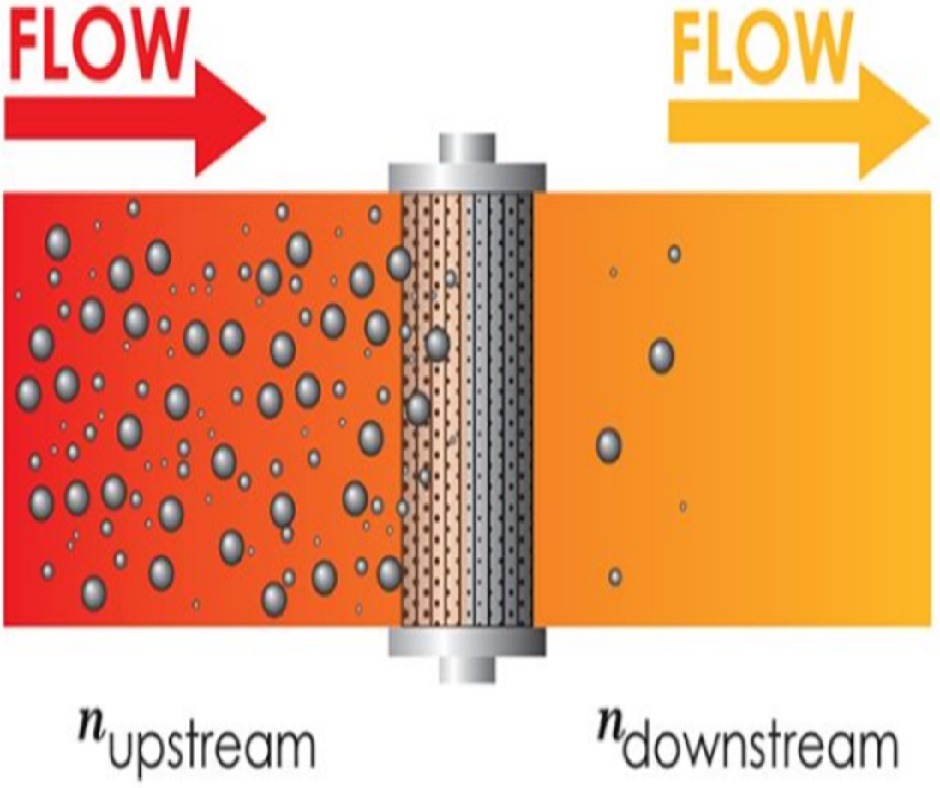
Table of Contents

Nominal Ratings

In my experience, asset operators are often mis-led into a false sense of security by the ‘Nominal Filter Rating’ certified by the manufacturers of lube oil filtration systems. Simply put, an oil filter rating ‘claim’ by the filter manufacturer in the OEM manual is akin to the commonly heard “99.99% germs killed” claim by a few toothpaste, disinfectant and soap manufacturers to appease germaphobes: a marketing gimmick- to be viewed with suspicion!
Nominal Ratings have little veracity. On a visit to Rubber Manufacturing Unit once, I noticed a gearbox with a 10 micron filtration unit installed. Upon further investigation and a few lab oil tests later, I emailed the GM Maintenance that the particles that found their way through these filters were larger than 30 microns. The GM instantly called me seeking a justification. Beta Ratio: A “nominal” rating is a value given by filter manufacturers based on a percentage of particulate weight removed during testing. Nominal ratings are unreliable as micron sizes of these particulate matter as well as testing methods can vary. What they don’t tell you is the percentage of particulate contaminants above a certain size that pass through the filter. This is where the Beta Ratio comes in. Tribologists at organizations like Noria Corporation have long argued that the Beta Ratio of Oil Filters must be calculated to accurately measure the effectiveness of your oil filter.
The Beta Ratio is a number derived by dividing the number of particles in the upstream (before filtration) of a particular size divided by the number of particles downstream (after filtration) of a particular size. The Beta rating comes from the Multi-pass Method for evaluating performance of a fine filter element (ISO 16889:1999) (Advanced Fluid Systems).

How to calculate beta ratio of filter?

Assuming you have a 10 micron filtration system and wish to calculate the Beta Ratio of your filter. Let’s break down the steps:
(Image Courtesy:
Particles larger than 10 micron before filtration vs Particles larger than 10 micron after filtration.

Similarly, if a 10 micron filter has 2,00,000 particles downstream, instead of 20,000, the 𝛃 Ratio would be 90%, a substantial difference from 99% in the illustrated example. The Table Below (by Machinery Lubrication) is a simple illustration of the 𝛃 Ratios and Their associated Efficiencies.
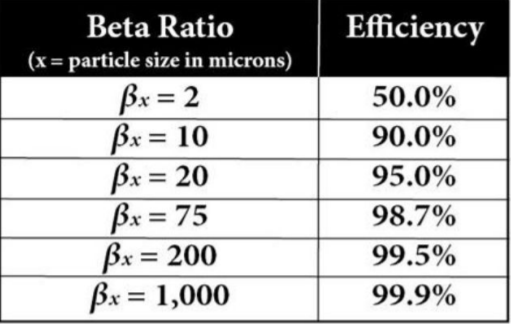
(Image Courtesy: Noria Corporation)

Conclusion

Along with the Absolute Ratings (An absolute rating gives the size of the largest particle that will pass through the filter or screen), Beta Ratios are a good way to qualitatively judge the efficacy of filters. However, in addition to the Beta Ratio, one must also consider observing the dirt-holding capacity (the contaminant particulate matter) of the filter and its Pressure-Flow rating.
At Neptunus, we provide filtration units with elements that have a Beta Ratio of up to 925, or an efficiency of 99.89%. You can write to us at info@neptunus-power.com or visit us at www.neptunus-power.com for more information.

How to Calculate Oil Filter Beta Ratio

The biggest factor before selecting your oil filtration systems is the Beta Ratio of your filters. It is the single most accurate way of judging the efficacy of your filters.
Watch the below video to know How to Calculate Oil Filter Beta Ratio.

Leave a Reply

0 Comments
Oldest
Newest Most Voted
Inline Feedbacks
View all comments
Related Posts
*The demo link will be shared only if a valid work or company email ID is provided.